


Perspective / AI-built software
Why the first AI-built version of a website often struggles with real traffic
AI tools are a good way to start. The trouble comes later, and it is predictable.
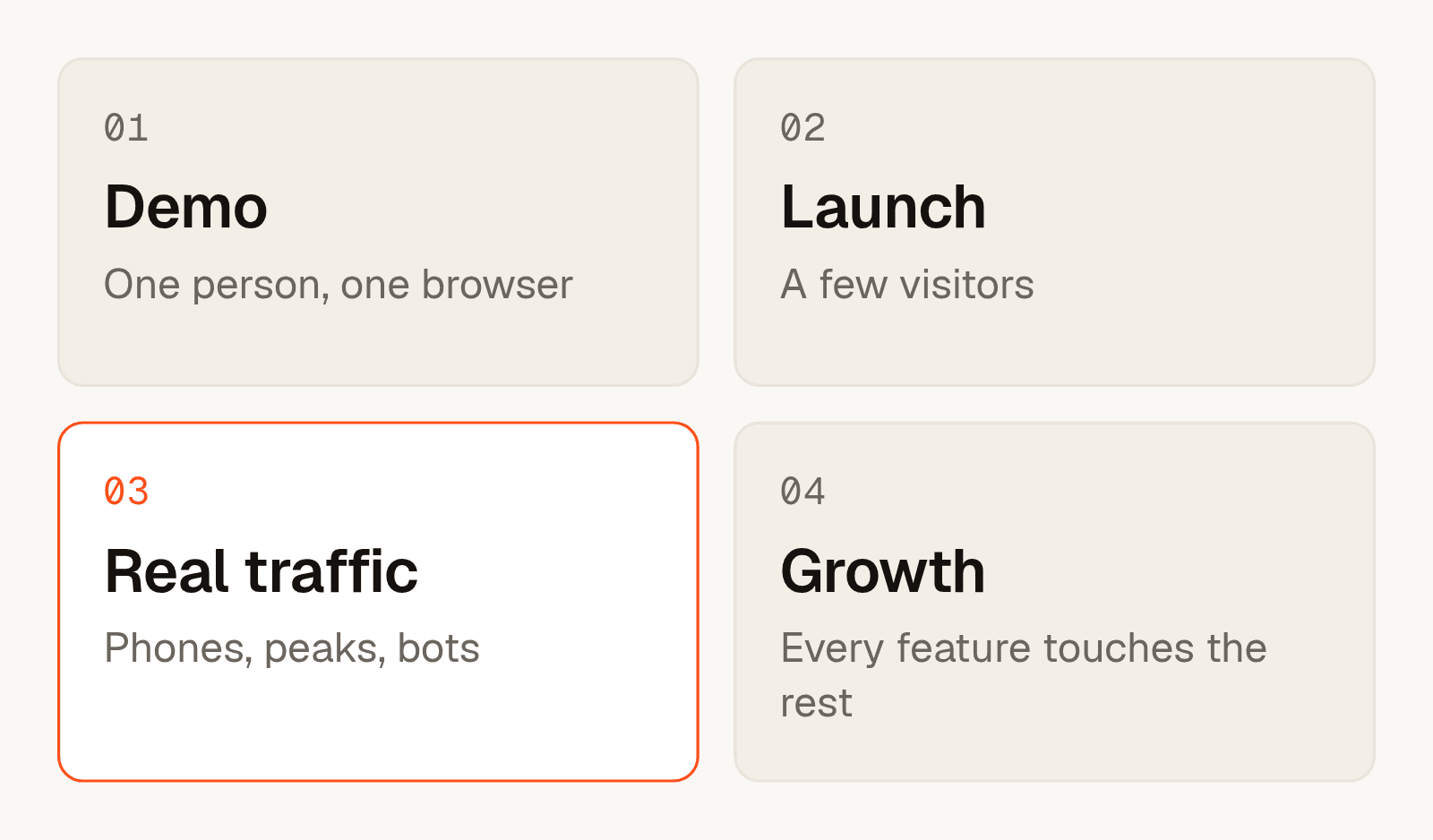
Short answer: an AI-built first version is built to work in front of its author. Real traffic brings phones, peak hours and many users at once, and that is where hidden weight shows up. The fix is rarely a bigger server. It is a review of what the site loads and what the database does.
We work from Saigon (Ho Chi Minh City) and use AI tools every day, so this is not an argument against them. Starting this way is a reasonable way to test an idea. The question is what to do when the idea works.
What AI tools optimise for
An AI tool answers the prompt in front of it. It wants the screen to look right and the button to work now. It does not know that you will have ten times more products next year, or that most visitors use a phone on a weak connection.
This is not a flaw in the tool. It is the gap between a demo and a system, and an engineer’s job is to close it.
Where it breaks first
- Heavy first screen. Too much script and too many large images, so phones wait.
- Queries without indexes. Fast with ten records, slow with ten thousand.
- Logic in many places. The same rule copied in several screens, so a fix in one place misses the others.
- Checks only in the browser. They look safe but the server accepts anything.
- Nobody owns the structure. Each new prompt adds a layer, and nobody can say how the whole fits.
Why a bigger server rarely helps
A bigger server makes a slow query slightly less slow. It does not remove the query. It also raises the monthly bill every month. Trimming what the site loads and fixing the few worst queries usually gives more than any hardware change.
When AI alone is enough
A page for a weekend event or a short campaign does not need an engineer. Neither does an internal tool for three colleagues. Once customers pay, log in or depend on the site every day, get a second opinion.
You can start with the pre-launch checklist and then decide whether to ask for a system health check.
Frequently asked questions
Why is my AI-built website slow?
The usual causes are a heavy first screen, queries without indexes and logic repeated in many places. A short review finds which one applies.
Should I stop using AI tools?
No. They are a good way to start. Add human review once real customers depend on the result.
Will buying a bigger server fix it?
Rarely. It hides the problem for a while and raises the monthly bill. Fixing the cause is better.
How do I know if I need an engineer?
If customers pay, sign in or use the site daily, and it feels slow or fragile, get a review. For a short campaign page, you probably do not.
Do I have to rebuild from scratch?
Usually not. Most sites can be saved by fixing a few parts. We say so clearly when the foundation is wrong. Read fix or rewrite.
What does a review from Haikotek include?
We measure the key paths, read what is running and return a ranked list of causes with a fixed quote for each fix. See custom software by stage if you need more than fixes.